Revision fixation
Loose or broken implants are removed and the fracture is fixed again with a more stable construct, such as a larger nail or an additional plate.
Complex Trauma
Most fractures heal within a few months. Sometimes a fracture heals very slowly (delayed union) or stops healing altogether (non-union). The plate, rod or screws holding it can also loosen or break.
A fracture that has not healed does not usually heal by waiting longer. Finding out why it has not healed, and correcting that cause, is the key to success.
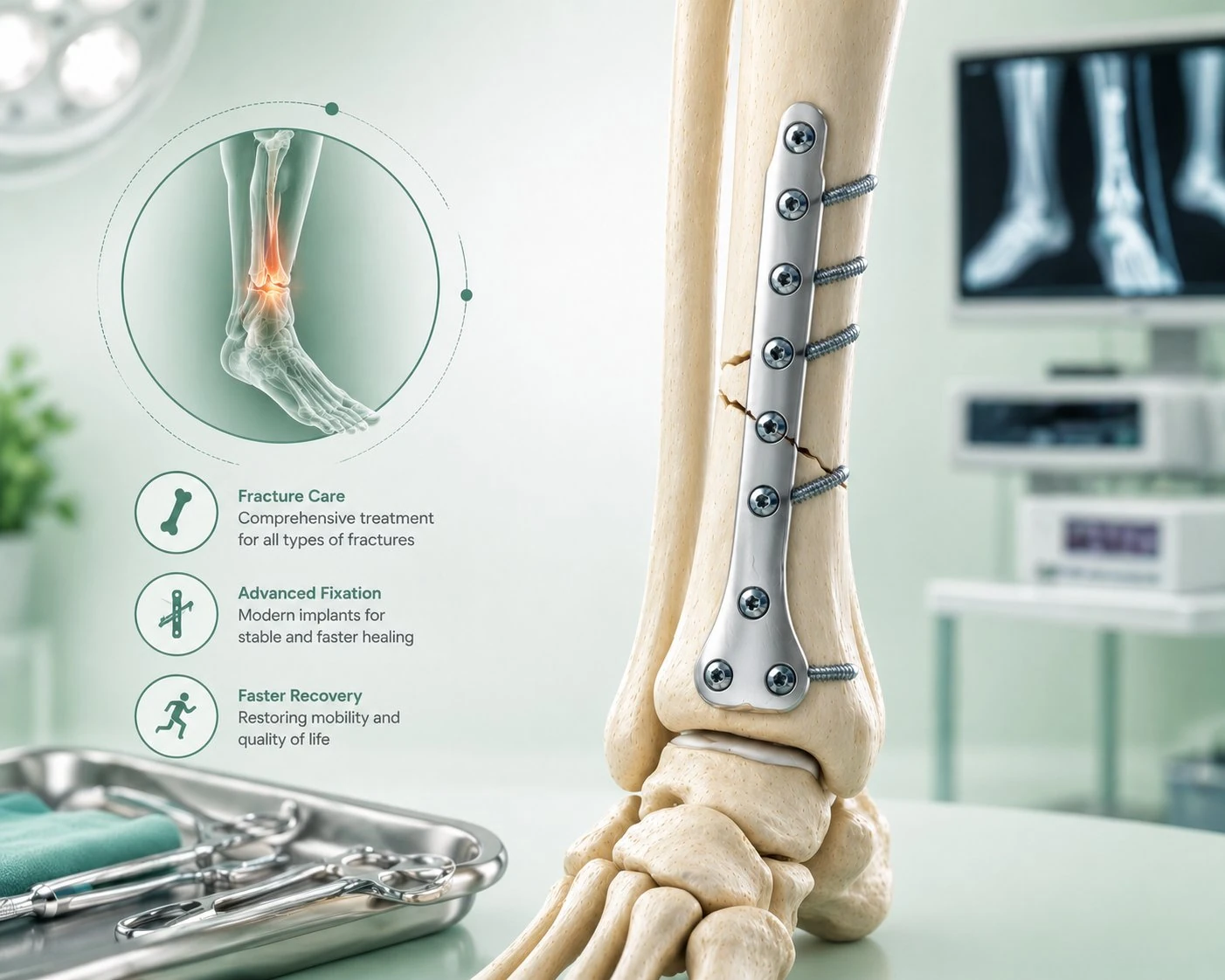
Complex Trauma & Fracture Surgery
Advanced orthopaedic care in Lucknow
Bone needs three things to heal: stability, a good blood supply and a healthy biological environment. Non-union happens when one or more of these is missing.
X-rays over time show whether healing has progressed. A CT scan shows how much bone has bridged the fracture. Blood tests check for infection and for problems such as low vitamin D or uncontrolled diabetes. When infection is suspected, samples are taken during surgery.
Bring all your old X-rays, CT scans and previous operation notes. They help show what has already been tried.
Treatment targets the specific reason the fracture has not healed.
Loose or broken implants are removed and the fracture is fixed again with a more stable construct, such as a larger nail or an additional plate.
Healthy bone, often taken from the patient's own pelvis, is placed at the fracture to stimulate healing and fill gaps.
Infected bone and tissue are cleaned away in theatre, followed by targeted antibiotics. Fixation may be done in stages.
If the bone has healed or is healing in a bent or shortened position, alignment can be corrected during revision surgery.
Stopping smoking, controlling diabetes, correcting vitamin D and nutrition. These make a real difference to the outcome.
| First weeks | Wound healing, physiotherapy for nearby joints, and protected weight bearing as advised. |
|---|---|
| 6–12 weeks | X-rays check early healing, and activity increases step by step. |
| 3–6 months and beyond | Non-unions often take longer than the original fracture to heal fully. Regular follow-up continues until the bone has united. |
Healing time depends on the bone, the cause of non-union and your general health.
Medanta Lucknow
OPD - B Wing, 2nd Floor, Medanta, Sector A, Pocket 1, Amar Shaheed Path, Golf City, Lucknow, Uttar Pradesh 226002
Indira Nagar Clinic
1D, near Khan Dairy Road, Block A, Indira Nagar, Lucknow, Uttar Pradesh 226016
Short videos from Dr Hatif Siddiqui’s YouTube channel.
अगर फ्रैक्चर के कई महीने बाद भी दर्द है, हड्डी हिलती महसूस होती है, या X-ray में प्लेट या रॉड टूटी या ढीली दिखे, तो हड्डी शायद जुड़ नहीं रही है। सिर्फ़ इंतज़ार करने से यह आमतौर पर ठीक नहीं होता। कारण ढूँढकर, स्थिर फिक्सेशन और ज़रूरत पड़ने पर बोन ग्राफ्ट से इलाज किया जाता है। अपने पुराने X-ray और ऑपरेशन के कागज़ साथ लाएँ।
A non-union is a fracture that has stopped healing and will not heal without further treatment. Delayed union means healing is happening, but more slowly than expected.
Warning signs include continuing pain months after the injury, pain on weight bearing, movement at the fracture, a bending limb, or a loose or broken implant on X-ray. An X-ray and often a CT scan confirm it.
An implant usually breaks because the bone has not healed and the metal has been carrying the load. It needs assessment of why the bone did not heal, followed by revision surgery with more stable fixation, often with bone grafting.
Some delayed unions improve by correcting factors such as smoking, vitamin D or diabetes, or by adjusting weight bearing. An established non-union usually needs surgery.
Yes. Smoking and tobacco reduce blood flow to the bone and significantly increase the risk of non-union. Stopping completely is strongly advised.
Medanta Lucknow and the Indira Nagar clinic. Bring your X-ray, MRI or CT scan and any previous operation notes.