1. Protect and settle
Control pain and swelling, protect healing tissue, and keep the rest of the body active.
Arthroscopy & Sports Injury
Getting back to your sport safely matters as much as the treatment itself. Returning too early is one of the most common reasons for a second injury.
This guide covers what to do straight after an injury, the phases of rehabilitation, typical timelines for common injuries, and the checks to pass before you play again.
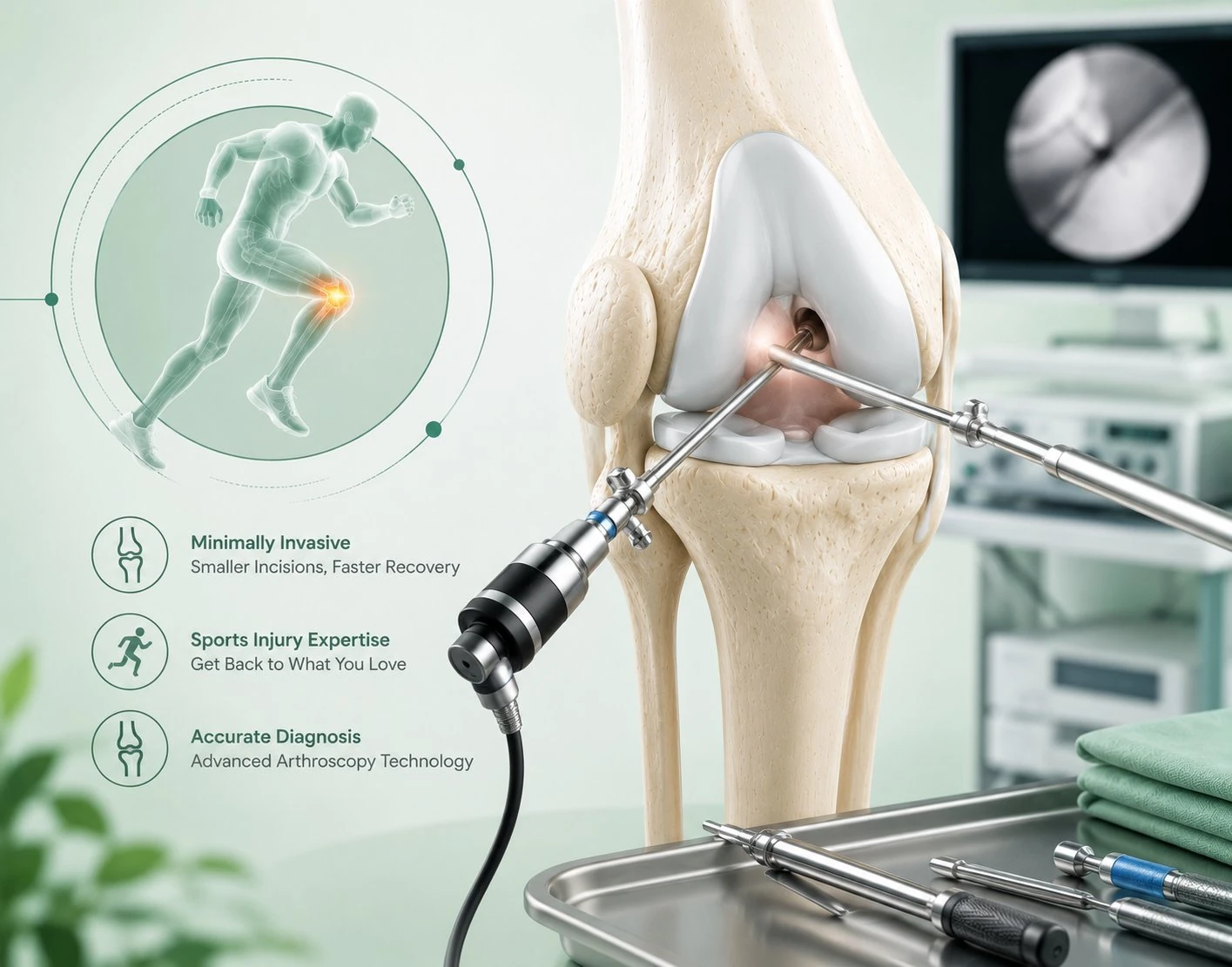
Arthroscopy & Sports Injury Care
Advanced orthopaedic care in Lucknow
Seek urgent care: if you cannot put weight on the leg, the joint looks deformed, there is rapid swelling within hours, the knee locks, or there is numbness, severe pain or a wound over the injury.
Early care reduces pain and swelling and protects the injured tissue while it is assessed.
Time alone does not decide it. Before returning, the injured side should have full or near-full movement, no swelling, and strength close to the other side. It should also pass sport-specific tests such as hopping, cutting and landing for knee injuries, and throwing or overhead strength for shoulder injuries.
Returning in stages, from training to non-contact practice to full match play, lowers the risk of re-injury.
Whether or not you need surgery, recovery follows the same broad phases.
Control pain and swelling, protect healing tissue, and keep the rest of the body active.
Regain the full range of motion and normal walking or arm movement, without pain.
Progressive strengthening of the injured area and the muscles that support it, such as the hip and core for knee injuries.
Balance, landing and movement-control training to protect the joint during sport.
Running, cutting, jumping or throwing drills that match your sport, gradually increasing in speed and load.
Back to full training, then competition, once the return-to-sport checks are passed.
| Mild ankle sprain | About 1–3 weeks |
|---|---|
| Moderate ankle sprain | About 3–6 weeks |
| Stress fracture | About 6–12 weeks, depending on the bone |
| Meniscus trimming | About 4–6 weeks |
| Meniscus repair | About 4–6 months |
| Shoulder stabilisation | About 4–6 months |
| ACL reconstruction | About 9–12 months |
These are typical ranges. The actual return depends on the injury, the treatment, your sport and passing the return-to-sport checks.
Medanta Lucknow
OPD - B Wing, 2nd Floor, Medanta, Sector A, Pocket 1, Amar Shaheed Path, Golf City, Lucknow, Uttar Pradesh 226002
Indira Nagar Clinic
1D, near Khan Dairy Road, Block A, Indira Nagar, Lucknow, Uttar Pradesh 226016
Short videos from Dr Hatif Siddiqui’s YouTube channel.
चोट के बाद पहले 48 घंटों में आराम, बर्फ़, पट्टी और पैर ऊपर रखना मदद करता है। खेल में वापसी सिर्फ़ समय से नहीं, बल्कि पूरी ताक़त, पूरी मूवमेंट और बिना सूजन के तय होती है। जल्दी लौटना दोबारा चोट का सबसे बड़ा कारण है। सही प्लान के लिए परामर्श लें।
It depends on the injury: a mild ankle sprain may take 1–3 weeks, while ACL reconstruction usually takes 9–12 months. The decision should be based on strength, movement and sport-specific tests, not on time alone.
Use ice, not heat, in the first 48 hours, for 15–20 minutes at a time with a cloth between the ice and your skin. Heat and massage can increase swelling early on.
Prehab is exercise before surgery to build strength and movement. Patients who start surgery with a stronger, less swollen joint usually recover faster afterwards.
See a doctor if you cannot bear weight, the joint is deformed or locks, swelling comes up quickly, there is numbness, or pain is not improving after a few days of rest.
Complete the full rehabilitation, return in stages, keep up strength and balance work, warm up properly, and don't play through pain.
Medanta Lucknow and the Indira Nagar clinic. Bring your X-ray, MRI or CT scan and any previous operation notes.