Physiotherapy and medicines
Strengthening the remaining cuff and shoulder-blade muscles, with short courses of medicine. Works well for many partial tears and wear-related tears in older patients.
Arthroscopy & Sports Injury
The rotator cuff is a group of four tendons that hold the ball of the shoulder in its socket and help you lift and turn your arm. A tear can come from a fall or a heavy lift, or from gradual wear after the age of 40.
Many rotator cuff problems improve without surgery. Tears that cause lasting weakness, or sudden tears from an injury in active people, often do better with arthroscopic repair.
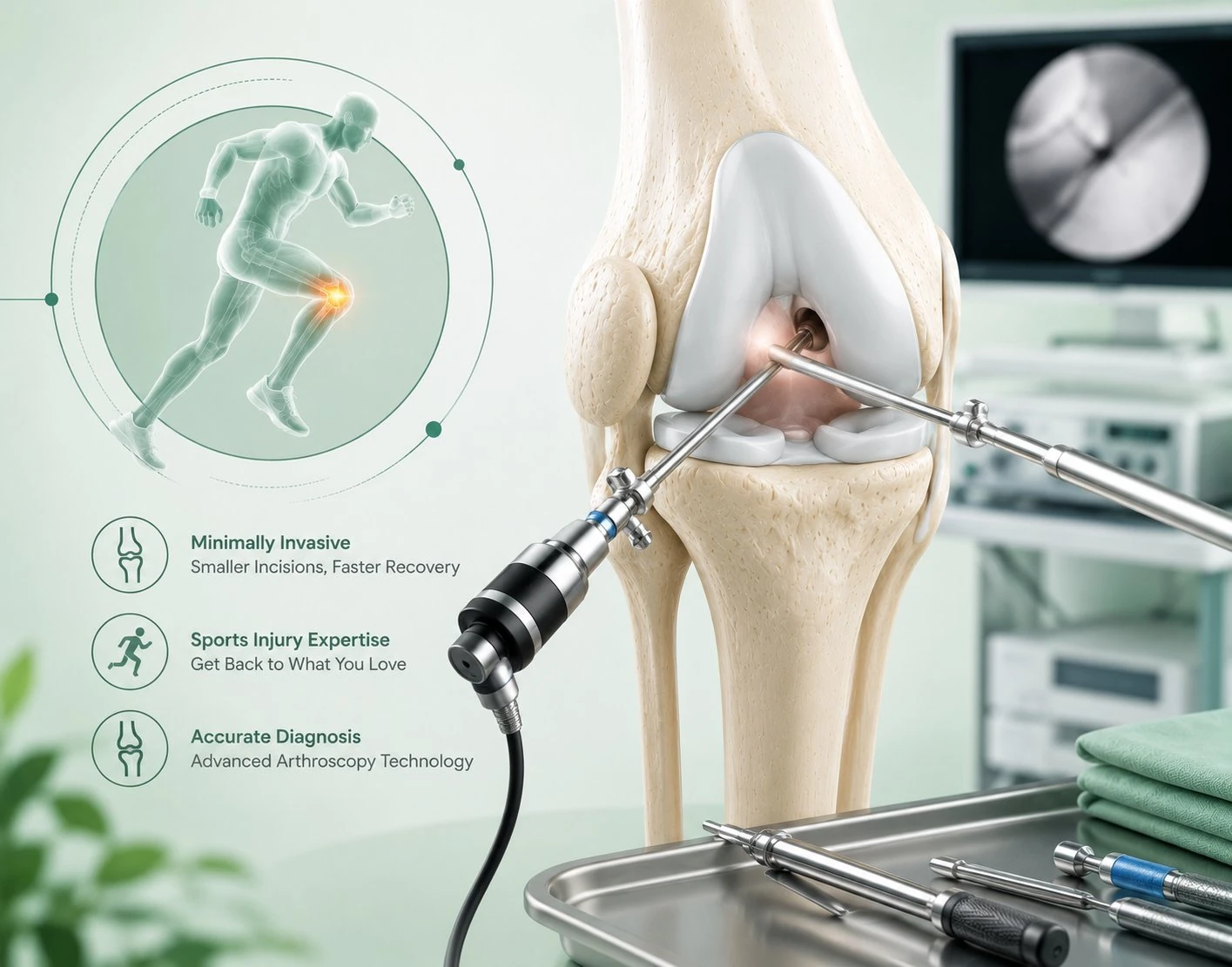
Arthroscopy & Sports Injury Care
Advanced orthopaedic care in Lucknow
Night pain and pain lifting the arm are also caused by impingement, tendinitis, frozen shoulder, arthritis and even neck problems. An accurate diagnosis matters because the treatments are very different.
Examination tests the strength of each tendon. An ultrasound or MRI shows whether there is a tear, how big it is, and whether the muscle is still healthy enough to repair.
The choice depends on the size and type of tear, how it happened, your age, activity level and how much weakness you have.
Strengthening the remaining cuff and shoulder-blade muscles, with short courses of medicine. Works well for many partial tears and wear-related tears in older patients.
A carefully placed injection can calm inflammation so that physiotherapy becomes possible. It is used selectively, not repeatedly.
The torn tendon is stitched back to the bone with small anchors through keyhole cuts. Recommended for tears from an injury in active people, and for tears causing lasting weakness despite physiotherapy.
The tendon needs time to heal back to the bone, so recovery is gradual. Following the physiotherapy plan closely is the most important part.
| 0–6 weeks | Arm in a sling. The physiotherapist moves the shoulder gently while the repair heals. |
|---|---|
| 6–12 weeks | Sling off. Active movement is restored step by step. |
| 3–6 months | Strengthening. Most daily activities are comfortable. |
| 6–12 months | Full strength returns. Heavy lifting and overhead sport are resumed gradually. |
Typical ranges; larger tears take longer.
Medanta Lucknow
OPD - B Wing, 2nd Floor, Medanta, Sector A, Pocket 1, Amar Shaheed Path, Golf City, Lucknow, Uttar Pradesh 226002
Indira Nagar Clinic
1D, near Khan Dairy Road, Block A, Indira Nagar, Lucknow, Uttar Pradesh 226016
Short videos from Dr Hatif Siddiqui’s YouTube channel.
रोटेटर कफ कंधे की चार नसों (टेंडन) का समूह है। रात में कंधे का दर्द और हाथ उठाने में कमज़ोरी इसके आम लक्षण हैं। हर कंधे के दर्द का मतलब टियर नहीं होता; कई मरीज़ फ़िज़ियोथेरेपी से ठीक हो जाते हैं। ज़रूरत पड़ने पर दूरबीन से टेंडन को हड्डी से दोबारा जोड़ा जाता है।
A torn tendon rarely heals back to the bone by itself, but many people, especially with partial or wear-related tears, become comfortable and strong with physiotherapy. Surgery is advised when weakness persists or the tear followed an injury in an active person.
No. Night pain is also common with impingement, tendinitis and frozen shoulder. An examination and, where needed, an ultrasound or MRI confirm the cause.
The arm is in a sling for about 4–6 weeks, followed by months of physiotherapy. Most daily activities are comfortable by 3–6 months, and full strength can take 6–12 months.
A sudden tear from an injury in an active person is best assessed early, because tendons can pull back and the muscle can weaken over time, making repair harder. Wear-related tears are usually less urgent.
Yes, most repairs are done arthroscopically through small cuts, using anchors placed in the bone to hold the stitched tendon.
Medanta Lucknow and the Indira Nagar clinic. Bring your X-ray, MRI or CT scan and any previous operation notes.